Played in demo · Pragmatic Play
Buffalo King Megaways, played in demo, where the number of ways changes every spin
Buffalo King Megaways takes a familiar prairie theme and puts it on a "Megaways" engine, where the height of every reel changes on every spin and with it the number of ways to win. The rules screen prints three different returns for three ways of playing, which makes it a useful game for learning how much the small print can vary inside a single title.
The game in one paragraph
Buffalo King Megaways is a Pragmatic Play slot built on the Megaways mechanic, which the provider uses under licence from Big Time Gaming (the studio that invented it). Each spin draws a new height for each of the six reels, and the number of "ways" (combinations of adjacent reels on which matching symbols pay, from left to right) is the product of those heights, so that it changes on every spin up to a maximum of 200,704.
Winning symbols disappear in a "tumble" and new ones fall in, as in Gates of Olympus (also tested here), and the "wild" appears only on the four middle reels. We played the provider's generic demo on November 12, 2026, at a stake of 2.00 in demo credits; a registered Alberta site may run another version, with a different return or with features switched off.
- Provider
- Pragmatic Play, Megaways under licence from Big Time Gaming
- Reels
- 6; reels 1 and 6 up to 7 symbols, reels 2 to 5 up to 8 counting a top row that spins right to left
- Ways
- up to 200,704, changing every spin
- Return to player
- 96.52%; 96.49% with the ante bet; 96.50% with the free-spins buy
- Volatility
- high, as the game's own label put it
- Stake
- from 0.20 to 300 per spin
- Maximum win
- 5,000 times the stake
Three returns for one game
The rules screen gives the return as 96.52 per cent for ordinary play, 96.49 per cent with the "ante bet" (a stake of 25 times the base, which doubles the chance of triggering "free spins" and switches off the buy) and 96.50 per cent when free spins are bought outright for 100 times the stake. The differences are tiny, and we would not choose a way of playing on the strength of three hundredths of a point (0.03 points at most).
What the three figures show is something more general and more useful. A return is a property of a way of playing, not of a title, and the same game can carry different figures depending on the options chosen (and, on a registered site, on the setting the operator has selected from those the provider offers).
Free spins, and multipliers that multiply
Four, five or six "bonus symbols" award twelve, seventeen or twenty-two free spins and pay five, twenty or a hundred times the stake (the bonus symbol is the game's scatter), and three or more during the spins add five more, without limit. During free spins each wild carries a "multiplier" of 2x, 3x or 5x, and multipliers on the same winning combination are multiplied together rather than added (two wilds at 5x make 25x, not 10x), which is where the "high volatility" comes from.
That arithmetic explains the game's character: most spins pay little or nothing, a few pay modestly, and very rarely a sequence of wild multipliers produces a large win, which is the event the volatility label warns about; the average of all that is the 96.52 per cent, while the experience of any one evening is dominated by the long stretches between the rare events!
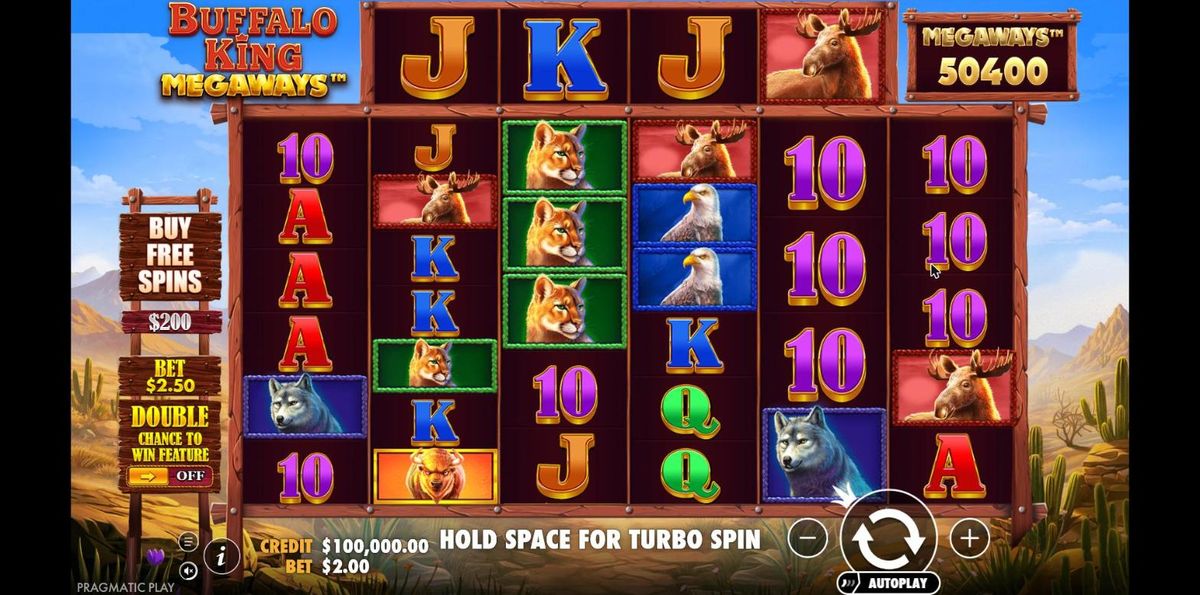
Our session
We played three spins at 2.00 and won nothing on any of them, which in this game is normal. The two that had settled when we stopped (the third had not finished when we took the "screenshot") cost 4.00, taking the balance from 100,000.00 to 99,996.00 demo credits, and the number of ways moved from 50,400 on one spin to 2,880 on another, which shows how widely the engine swings from one spin to the next.
Fifty thousand ways sounds like a promise, and it is not one. The number of ways counts the combinations that could pay, while the chance of any of them paying depends on the symbols the reels actually draw; a spin with 50,400 ways and no win, like the one in our screenshot, is an ordinary event in a game of this kind.
The paytable at 2.00
The bison is the symbol that matters, and the "paytable" shows you how steeply the values fall away beneath it. Six bison paid 40.00 at a stake of 2.00 (twenty times the stake), five paid 20.00, four 8.00, three 4.00 and two 2.00, while six eagles paid 12.50, six pumas 7.50, six wolves or six elk 3.00, six aces or kings 2.00, six queens 1.50 and six jacks or tens 1.20.
Take a hypothetical player. At 2.00 a spin for an hour, perhaps five hundred spins, that player stakes 1,000.00 and loses 34.80 on average at the ordinary return, with a range around that figure so wide in a high-volatility game that the average describes almost nobody's actual evening (which is exactly why a "loss limit" set in advance is worth more than any reading of the paytable).
On a registered Alberta site
The version in a "registered lobby" may carry a different return setting from the demo, and we would check the rules screen on the site itself before staking money, comparing the figure printed there with the 96.52 per cent we read. You should also check whether the ante and the buy are available, since an operator may switch features off (both are options the provider offers, not obligations).
The other games we tested are on the games page, and the general mechanics of reels, ways and volatility are explained on how a slot decides. For what a return figure is an average of, and how long that average takes to appear, the page on return to player goes further than we can here.
By the Alberta Casinos Online editorial team · Last updated: November 13, 2026 · Online since 2026