Played in demo · Play'n GO
BlackJack MH, played in demo, and the hand that basic strategy plays for you
Blackjack is the one casino game in which the player's decisions change the house's margin, and the rules printed on the felt decide how much those decisions are worth. We played a single hand of Play'n GO's BlackJack MH, an eleven against the dealer's two, and the textbook answer to that hand happens to illustrate the whole game.
The game in one paragraph
BlackJack MH is a Play'n GO table game released on October 25, 2012, where "MH" stands for "multi-hand": the table has three "spots" (betting positions), and a player may play one, two or all three against the same dealer. The felt prints the three rules that matter most, "Blackjack pays 3 to 2", "Dealer must stand on 17 and draw to 16" and "Insurance pays 2 to 1", and the limits in the practice version run from 1 to 100 a spot.
We played the provider's practice version on November 12, 2026, with a demo balance of 25,000.00. A registered Alberta site may carry this game or one of many other blackjack variants, and the rules printed on the felt are the first thing to read, because they differ from one table to the next more than most players realize.
- Provider
- Play'n GO, released October 25, 2012
- Spots
- three, playable together against one dealer
- Rules on the felt
- blackjack pays 3 to 2; dealer stands on 17 and draws to 16; insurance pays 2 to 1
- Limits
- 1 to 100 a spot in the practice version
- Decisions offered
- hit, stand, double, split
- House edge
- depends on the full rules and on the player's decisions; not printed in the demo, so not quoted here
Our hand: eleven against a two
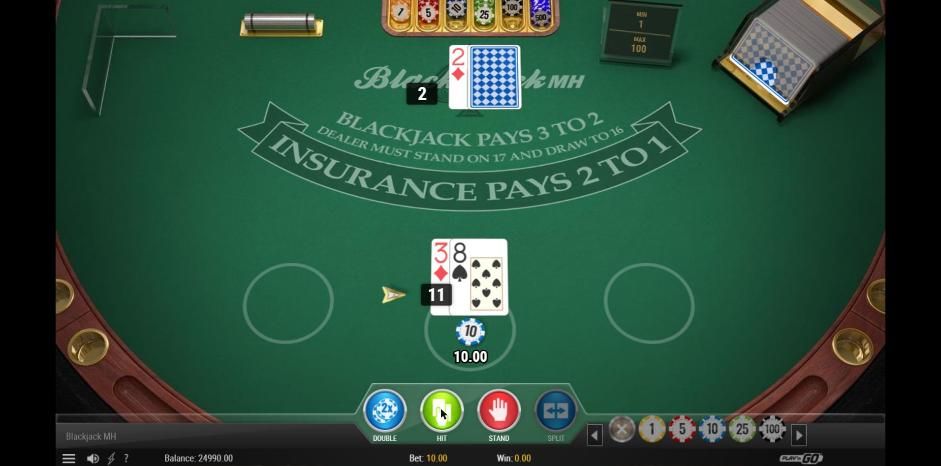
We bet 10 on the centre spot and were dealt a 3 and an 8, a total of eleven, against the dealer's 2, which was showing face up. Eleven is the best starting total in the game short of a blackjack itself, since any "ten-value card" (and there are sixteen of them in each deck) makes twenty-one, and the dealer's 2 is a weak card for the house, which is why the hand deserves more money.
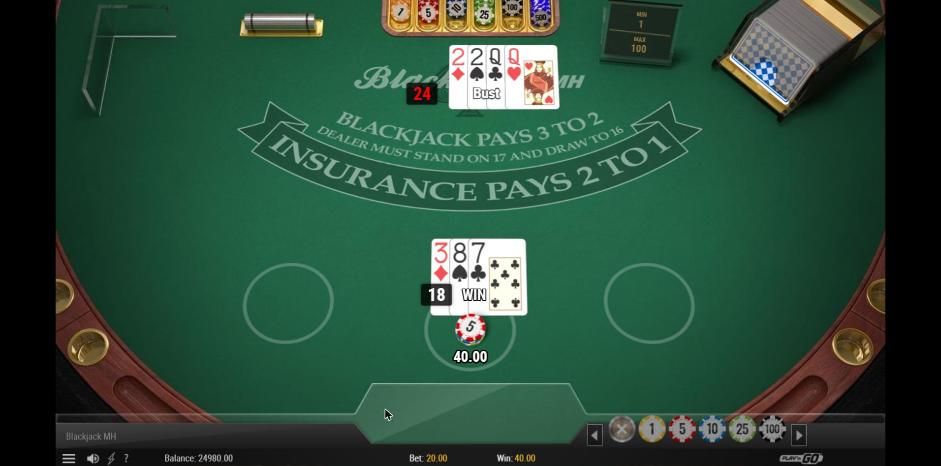
The textbook answer is to "double down" (doubling the stake in exchange for one more card), and that is what we did, because a player rarely gets the moment. The extra card was a 7, giving eighteen with 20 now at stake (the original 10, doubled). Then the dealer turned over another 2, drew a queen and then a second queen, reaching twenty-four and going "bust" (over twenty-one), so the hand paid 40 and the balance rose to 25,020.00.
Why the double is right, and why it did not matter
The double on eleven against a two is a move from "basic strategy", the set of decisions that minimizes the house's edge for a given set of rules, worked out by simulation over millions of hands. It is right because the hand is more likely to win than to lose and the extra stake goes in at the moment when the odds favour the player, which happens rarely in a casino and should not be wasted.
A single hand proves nothing. Ours proves even less than usual, since the dealer would have bust whatever the decision had been. Good decisions are measured over thousands of hands, while a single outcome is a coin with more sides; a player who judges a strategy by last night's results is doing what the hot numbers panel at the roulette table invites (and it is no wiser at a blackjack table)!
The rules that decide the house's margin
Three rules on this felt favour the player, if one compares them with common alternatives. A blackjack pays 3 to 2 (a table paying 6 to 5 takes noticeably more), the dealer stands on all seventeens, and doubling is allowed. Other rules (the number of decks, doubling after a split, surrender) also move the margin, and the demo does not print them all, which is why we quote no single figure for this game.
Insurance deserves a separate warning (whatever you have read about it). It pays 2 to 1 when the dealer's face-down card completes a blackjack, and basic strategy declines it in every variant we know, since the odds of that card being a ten are worse than the price implies; we would ignore the offer, however reasonable it sounds when the dealer shows an ace.
On a registered Alberta site
If you play blackjack on a registered site, read the felt before the first bet: 3 to 2 rather than 6 to 5, the dealer's rule on seventeen, and the options that it allows for doubling and splitting. Then play basic strategy for those rules ("strategy charts" that cover them are published freely), set a loss limit in the account, and keep an eye on the time, which passes faster at a table than anyone expects.
The page on blackjack explains the rules and the strategy at more length, live dealer tables covers the version played with a human dealer on video, and the games page lists the other games we tested.
By the Alberta Casinos Online editorial team · Last updated: November 13, 2026 · Online since 2026